

Read article
Software engineering
Staff engineers who join your team to improve how you build
Brownfield experts
Lead by example
Plan our exit from day one
We don't just improve your software, we care about the team as well
We work on software that already has users, history, and opinions. The kind where every change can break something, and “just rewrite it” is not an option. Our staff engineers join your team to unlock progress again.
We love legacy
Most of our work happens in brownfield and legacy systems. Code that has been around and accumulated debt, but still needs to perform. Cleaning up what matters while shipping real features gives us the thrills.
Leading staff engineers
Our engineers lead by doing. They write code, improve systems and refine processes. Since 2008, we have been cleaning up codebases. We join with a clear plan to leave and when we are done, the waters are calmer, the team is stronger, and progress is predictable again.
Our engineering playing field
We take on projects that make your product more robust. When the tech outgrows the team, we step in.

Backend engineering
Our developers join your team, take on tickets and lead by example. They dive into infrastructure, refactor APIs, improve performance, build CI/CD pipelines and make your backend something your team can rely on.
Discover moreReady to talk?
Ready to build a backend your product can rely on?
Frontend engineering
We modernise legacy frontends, clean up design systems, and fix performance and accessibility. We bridge design and engineering so what ships matches what was imagined, and users actually love using it.
Discover moreReady to talk?
Want a frontend that users love and your team can maintain?

Data & AI projects
We help teams make smart use of data and AI. Not for the hype, but for real impact. Whether it is setting up pipelines, integrating generative AI, or applying machine learning where it makes sense.
Discover moreReady to talk?
Looking to put data and AI to work in your product?
Mobile projects
We build and improve mobile applications with the same quality-first approach we bring to web. Native or cross-platform, we focus on performance, reliability, and a great user experience.
Discover moreReady to talk?
Ready to ship a mobile app your users keep coming back to?
Our approach
“We join with a clear plan to leave. When we are done, the waters are calmer, the team is stronger, and progress is predictable again.”
Why companies call us in
You don't call us when everything's going great. You call us when things kind of work, but don't feel right anymore. When progress feels heavier than it should.

“Our AI prototype works in a notebook but not in production.”

“We’re scaling faster than our processes.”

“We made the decision to onboard a madewithlove senior front-end engineer very early in our journey. This has been transformational: there was an immediate alignment on the mindset, on understanding wh…”
Thomas-Louis de Lophem, CEO at MinersAI

“Our company is scaling fast, but the software isn’t.”
“Releasing a new version takes an entire afternoon.”

“We enjoyed working with madewithlove for the qualitative feedback on our development flow, velocity, and attention to details they brought in our engineering team.”
Joel Harkes, Technical Team Lead at Vaigo

“My developers are not working together.”
“Our frontend is a mess and nobody wants to touch it.”
Happy clients
We've embedded staff engineers with dozens of SaaS teams to improve live software, mentor developers, and make progress sustainable.
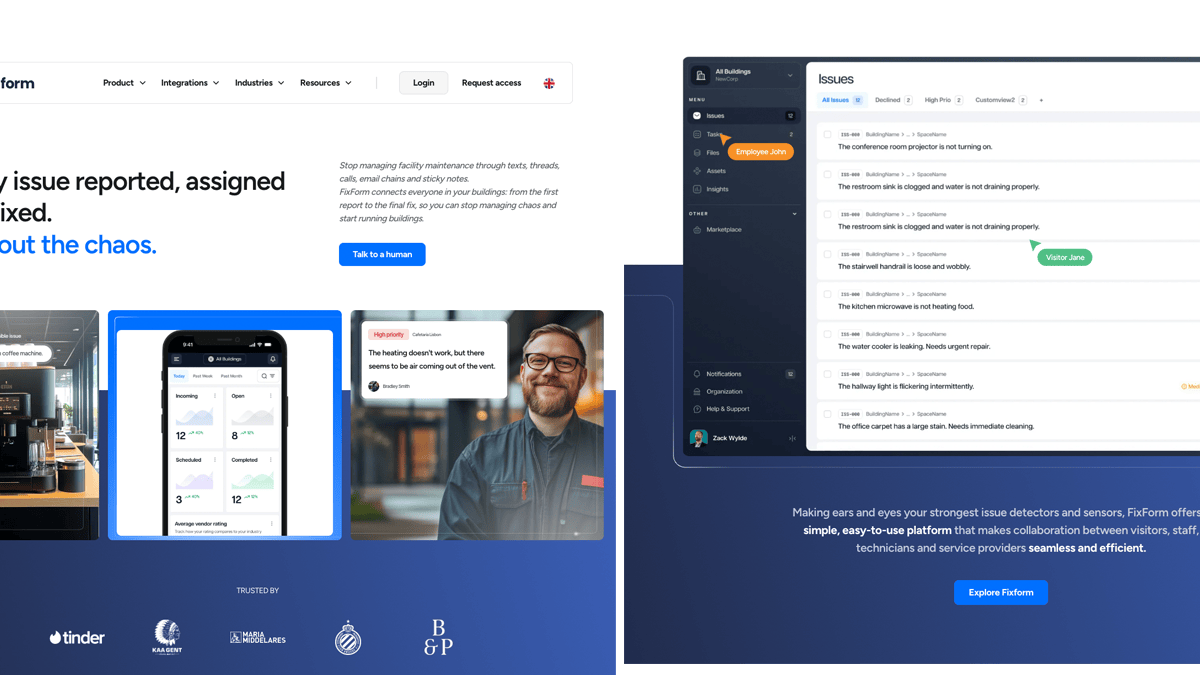
Fixform
Keeping buildings and spaces in good, safe and clean condition
After their technical co-founder departed unexpectedly, we stepped in with two staff engineers to build a quality-first MVP using Inertia.js, Vue, and Laravel. We established robust CI/CD pipelines, implemented comprehensive testing, and mentored the team through knowledge transfer.
Read case study
We help our clients succeed
You will not see companies like Amazon among our past clients. You will, however, see the names that will soon rock the SaaS world because we helped them predict risks and avoid failure.
“As a real transition-expert, Andreas helped us with creating the software. This wasn’t an easy task because our technical team had to grow alongside the number of clients.”

Jeroen De Wit
CEO, Teamleader

“We now have stable and performant products that users love, so the impact of the collaboration is well proven.”

Sven Houtmeyers
Technical Lead (CTO), Publiq

“The madewithlove team works alongside us, treated our product with the love and attention it deserved and actively challenged us throughout the entire product development process.”

Michelle Dassen
Head of Product, Flexmail

FROM 150+ SAAS AUDITS
1 in 4 SaaS teams give all engineers production access
Deploy rights, database credentials, secrets. Everyone has the keys.
The access problem nobody talks aboutLatest insights
Our latest thinking on software quality, team dynamics, and the craft of building better products.
Blog
Python as the new Latin
2 min read
Read article
Blog
Your codebase is a palimpsest
3 min read
Read article
Need engineering muscle?
Whether you need staff engineers to strengthen your team, help untangling a legacy codebase, or a fresh perspective on your architecture. We're ready to dig in.
Frequently asked questions
Everything you need to know about working with our staff engineers.
We don't take over but we join. Our engineers embed directly into your team, pairing with your developers, reviewing architecture, and introducing better practices. The goal isn't to replace anyone. It's to leave your team stronger than we found them.
Very direct. If something is broken, unclear, or slowing the team down, we say it out loud. Always respectfully, never theatrically. Clear problems are easier to fix than polite misunderstandings.
No. We are pragmatic rather than dogmatic. We do not impose frameworks for the sake of consistency or fashion. We work with your existing stack, constraints, and team.
Mostly SaaS startups and scale-ups that have found product-market fit but struggle to scale their product or team. We often step in when internal teams are stretched thin or early technical decisions start slowing things down.
We do both, but our sweet spot is brownfield development. Improving and evolving existing software. Whether it is modernising a legacy codebase or untangling a complex monolith, we bring structure and calm to environments where the pressure is highest.
Almost never. Most teams do not need a big rewrite. They need fewer fires, better predictability, and clearer ownership. We focus on stabilising what matters first, then improving quality where it actually pays off.
We are technology-agnostic, but most of our projects use modern web stacks such as React, Vue, Laravel, Symfony, and Node.js. We also handle infrastructure, cloud environments, and data and AI integrations.
Most engagements last between 6 and 18 months. We stay as long as we add real value. Long enough to fix structural issues, mentor your team, and make progress sustainable.
We begin with an honest conversation about your challenges, technical, organisational, or both. From there, we may do a short audit or technical due diligence to clarify the situation and define next steps. Once aligned, we embed and start improving things immediately.